
Angelina Parole and Probation Compared
Texas parole is conditional release from TDCJ prison before the full sentence expires. The person serves the balance under the TDCJ Parole Division. Mandatory supervision is also a supervised TDCJ release, but eligibility and review come from a separate statutory process. Probation, called community supervision in Texas, is imposed by a court and managed locally by a Community Supervision and Corrections Department. A probationer may never enter state prison.
These labels identify legal authority, not simply where someone slept before release. A person can leave the Angelina County Detention Center on bond and have no parole or probation. Another can leave court under probation. Someone discharged from the Diboll or Duncan Unit may enter parole or mandatory supervision. Use the judgment, TDCJ status, and current supervising office together.
| Record type | Who imposes it | Angelina County verification path |
|---|---|---|
| Parole | Texas Board of Pardons and Paroles | TDCJ offender and parole-review information, then the Nacogdoches District Parole Office |
| Mandatory supervision | Texas law and Board review for eligible cases | TDCJ status, IVSS, and Parole Division confirmation |
| Probation | The sentencing court | Angelina criminal docket, judgment, and Angelina CSCD |
- Parole
- Conditional release from state prison while the sentence continues under supervision.
- Probation
- A court-ordered term of community supervision that may replace confinement.
- Discharge
- Formal completion of the sentence or supervision term.
- Absconder
- A person alleged to have stopped reporting or left supervision without permission.
Check Angelina Post-Release Supervision
Begin with the legal event that put the person in the community. The TDCJ Online Inmate Search is useful for a person committed to state custody. It can show location, offense information, projected release information, and parole-review data. It is not an archive of short county-jail stays. For probation, use Angelina's Odyssey Public Access criminal docket to locate the sentencing court and judgment.
- Match the person by full name and, when available, TDCJ or state ID. Compare the county of conviction and offense so a common name does not produce a false match.
- Read the status carefully. A parole approval code permits or conditions release, but does not prove that physical release occurred.
- For a pre-vote parole question, call the Board status line at 844-512-0461. After approval, use the TDCJ release-status line at 512-406-5202.
- For probation, confirm the community-supervision judgment in the correct Angelina court and contact CSCD with the cause number.
- Ask whether supervision is active, discharged, transferred, or affected by a warrant. The office may limit what it discloses.
The Angelina County released-inmate search helps separate a county release from a TDCJ discharge or transfer. That distinction controls which office can answer the supervision question.
Angelina Supervision Offices and Records
Angelina County maps to the TDCJ Nacogdoches District Parole Office. Local probation stays with Angelina County CSCD in Lufkin. The state parole county cross-reference and Region I directory establish the parole assignment. No official public person-by-person parolee directory was found, so provide identifiers and ask a focused status question.
Nacogdoches District Parole Office
1113 Industrial Blvd.
Nacogdoches, TX 75964
Phone: 936-569-6234
Fax: 936-560-2716
Angelina County CSCD
P.O. Box 908
Lufkin, TX 75902-0908
Main: 936-634-3976
Fax: 936-639-9847
Reception: 936-633-7640
Court liaison: 936-633-7654
The Angelina Adult Probation page publishes staff roles and extensions. The official page shown below helps route a local probation question, but the staff directory does not make a protected case file public.
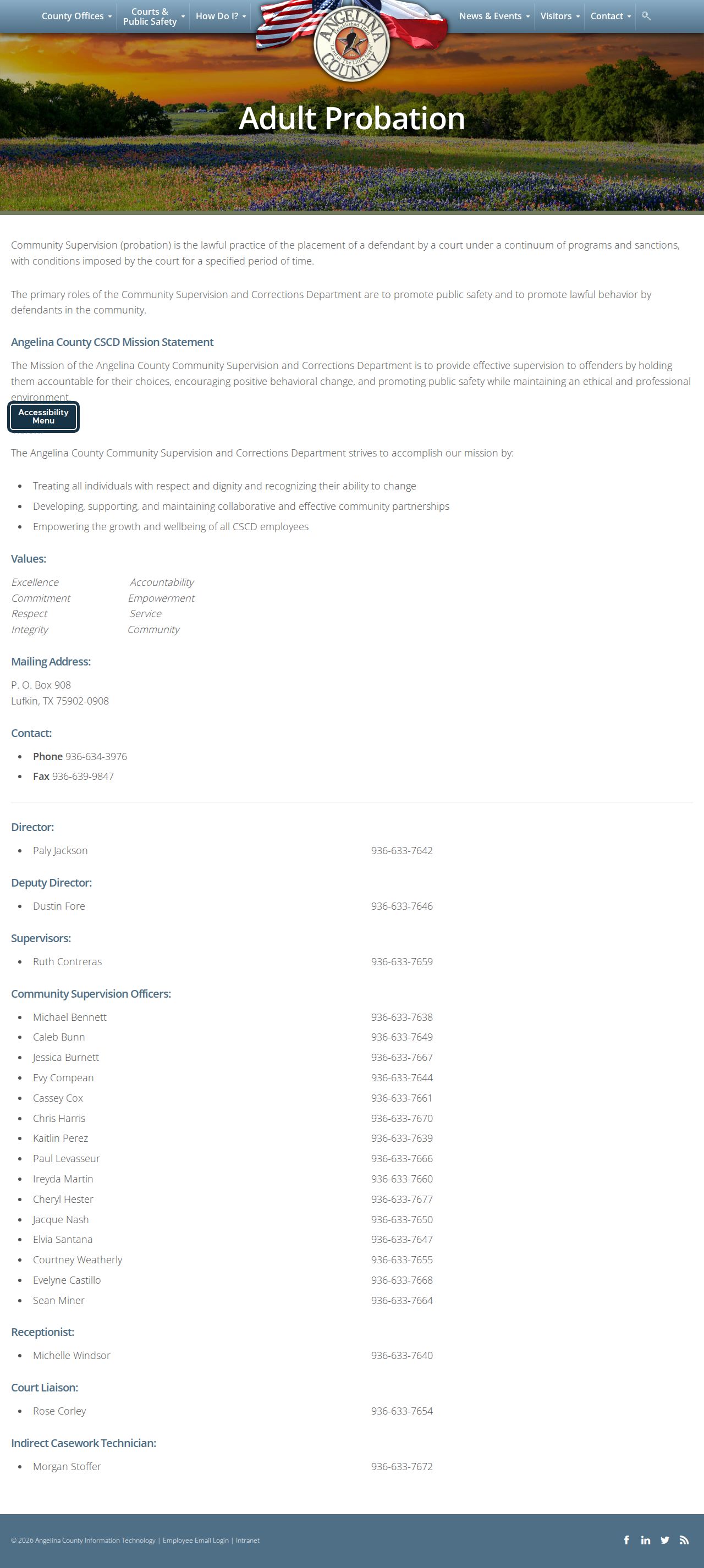
Use the receptionist or court liaison to identify the right unit, then provide the court and cause number when known. Do not assume the office can confirm every detail by telephone.
Where Angelina Parolees and Probationers Report
Angelina's local split is unusually concrete. A parolee assigned by county reports through TDCJ's district office in Nacogdoches, outside Angelina County. A probationer reports through Angelina CSCD in Lufkin. This difference can explain why a search at one office returns no record even when the person is under supervision elsewhere.
Start with the sentence source. A TDCJ number, parole-review record, or release from Diboll or Duncan Unit points toward state parole. An Angelina misdemeanor or felony judgment placing the person on community supervision points toward CSCD. If supervision transferred to another county, the originating judgment still helps identify the case, but the current office may have changed. Ask the listed office to confirm routing rather than treating a missing local result as discharge.
Angelina CSCD's detailed receptionist, court-liaison, and officer list makes navigation easier than a generic statewide directory. It remains an office contact list, not a public roster of supervised people. The distinct local route is the Research Section 19 supervision-office angle for this page.
Angelina Supervision Warrants and Violations
Conditions vary by order and case. They can include reporting, travel limits, treatment, fees, or other terms stated by the court or Parole Division. A violation allegation does not itself explain the final outcome. The supervising agency may investigate, issue instructions, seek a warrant, or begin revocation proceedings. A court or Board decision determines what follows.
An absconder or supervision warrant changes the meaning of “released.” The person may have completed the physical prison or jail exit but later become wanted for an alleged breach. Texas IVSS can send notices for some supervision-warrant actions and returns. The VINELink and IVSS check explains how county and state alerts differ. No separate official Angelina parole or probation absconder list was identified.
Absence from a public list is not proof that no warrant exists. Use TDCJ or the supervision office for current status. County warrants may follow a different sheriff or court path. Keep the release record, supervision record, and warrant question separate.
Angelina Parole Review Has No Calendar
Ordinary Texas parole review does not use a public hearing calendar. The Board's panel-review explanation says formal hearings are not held in the normal process. File preparation generally begins about six months before initial eligibility and about four months before a later review. Panel members review and vote separately.
A three-member panel usually needs two matching votes. Approval codes can authorize release when eligible, set a future date, or require a named program first. Denial codes can set the next review or require service of the balance, subject to mandatory-supervision rules. These codes are decisions, not proof of a gate exit. The person-specific result and TDCJ release-status channel replace a nonexistent chronological hearing list.
Eligibility under Government Code Chapter 508 depends on offense, offense date, sentence, and special categories. Eligibility permits review. It does not command release.
Confirm Angelina Supervision Discharge
Supervision ends through a formal legal event, not by the passage of an estimated date alone. For parole or mandatory supervision, obtain the current TDCJ status and discharge information. For probation, use the court docket and final order, then confirm with Angelina CSCD when needed. A completed supervision term differs from release from physical custody, and each has its own date.
Keep three records aligned: the jail or TDCJ release record establishes the custody exit, the judgment or Board action establishes legal authority, and the supervising agency record shows whether control continued afterward. A transfer, warrant, revocation, or new case can change the path. When a durable copy matters, request the existing record from its custodian rather than asking another office to interpret it.
Note: A projected end date is not a discharge record; verify the final status with the agency that supervised the case.
Public Record Search
Sponsored Results